

Introduction: Inconsistency Is Usually an Operating Problem
If you run a local service business, social media is rarely the only responsibility asking for your attention. Customers need answers. Employees need direction. Estimates, scheduling, job-site issues, paperwork, and unexpected problems all compete for the same limited time.
Facebook and Instagram often fall to the bottom of that list. You may intend to post later, then reach the end of another busy week without doing it. That doesn’t mean you don’t care about your business’s online presence. It usually means the work has no dependable place in the way your business operates.
Consistency becomes easier when you stop treating it as a test of motivation and start treating it as a management problem. The goal isn’t to be online constantly. It’s to create a realistic process that can continue even when the business gets busy.
Social Media Has No Clear Owner
One common reason social media becomes inconsistent is simple: nobody clearly owns it. The owner posts when time allows. An office employee helps occasionally. Someone in the field sends a photo. Everyone contributes a little, but no one is responsible for making sure the work moves from idea to finished post.
Shared participation can be useful. Shared accountability usually creates confusion. A team member may assume someone else is preparing the next post, checking the wording, or watching for customer comments. When the responsibility is vague, the work is easy to postpone.
Choose one person who is accountable for the process. That person doesn’t need to create every idea, take every photo, or write every sentence. The role is to keep the work moving, collect what the team provides, and know what needs to happen next.

There Is No Repeatable Content Workflow
A good intention is not a workflow. “We should post something this week” leaves too many questions unanswered. What should you talk about? Who has the information? Does anyone need to approve it? Is there a useful photo? When will it be prepared?
Without a repeatable path, every post starts from zero. That makes even a simple update feel like a separate project. A practical workflow can be short: capture an idea, collect the necessary details, draft the post, review it, and schedule or publish it.
Write those steps down and decide who handles each one. You don’t need a complicated dashboard or a long approval chain. You need a process your team understands well enough to repeat.
The Plan Depends on Finding Extra Time
Many small-business owners plan to work on social media when things slow down. The problem is that available time is unpredictable. A canceled appointment may create an opening one day, while a customer issue can take it away just as quickly.
If social media depends entirely on leftover time, it will keep losing to work with a clearer deadline. Give it a defined place instead. That might mean a protected planning block, a recurring handoff from the field to the office, or a regular review point before content is approved.
The amount of time matters less than whether the arrangement is realistic. A smaller routine that survives a busy month is more useful than an ambitious plan your team abandons after a week.
Every Post Becomes a New Decision
Social media feels heavier when every post requires a fresh round of decisions. You have to choose a topic, find the right words, locate an image, decide whether the message sounds like your business, and determine who should approve it. Repeating that process from scratch creates friction.
Reduce the number of decisions by defining a few useful subject areas your business can return to. Customer questions are a strong starting point because your team already answers them. You can also draw from services you want customers to understand, seasonal reminders, behind-the-scenes explanations, completed work you have permission to show, and practical advice related to your trade.
These aren’t rigid content formulas. They’re reliable starting points. When you maintain an idea list under a few clear subjects, you don’t have to wait for inspiration every time you sit down to prepare content.
The Standard Is Too Ambitious to Maintain
Consistency doesn’t mean posting constantly. It means choosing a rhythm your business can support and then following through. Problems begin when the plan is based on what sounds impressive rather than what your team can actually maintain.
A demanding schedule can create pressure to fill space, which may lead to rushed or forgettable content. It can also make a short interruption feel like total failure. Once the plan slips, the business may stop posting altogether instead of adjusting the routine.
Start with the level of activity you can manage without neglecting quality or customer responsibilities. You can revisit the rhythm as your process improves. The right plan is the one your business can carry out with care.
Publishing Is Separated From Customer Communication
Posting is only one part of maintaining a professional presence. Comments and direct messages also need clear ownership. A business can prepare content regularly while still leaving customer conversations without attention because publishing and response responsibilities were planned separately.
Decide who checks incoming conversations, what that person can answer, and which situations need to be escalated. Routine questions may be straightforward. Complaints, pricing exceptions, technical questions, or sensitive situations may require the owner or another qualified person.
Clear boundaries protect both responsiveness and judgment. Your team should know when it can help directly and when it needs to bring someone else into the conversation rather than guessing.
A Practical Consistency System
You don’t need to rebuild your entire marketing operation. Start with a small system that removes uncertainty and gives the work a dependable path.

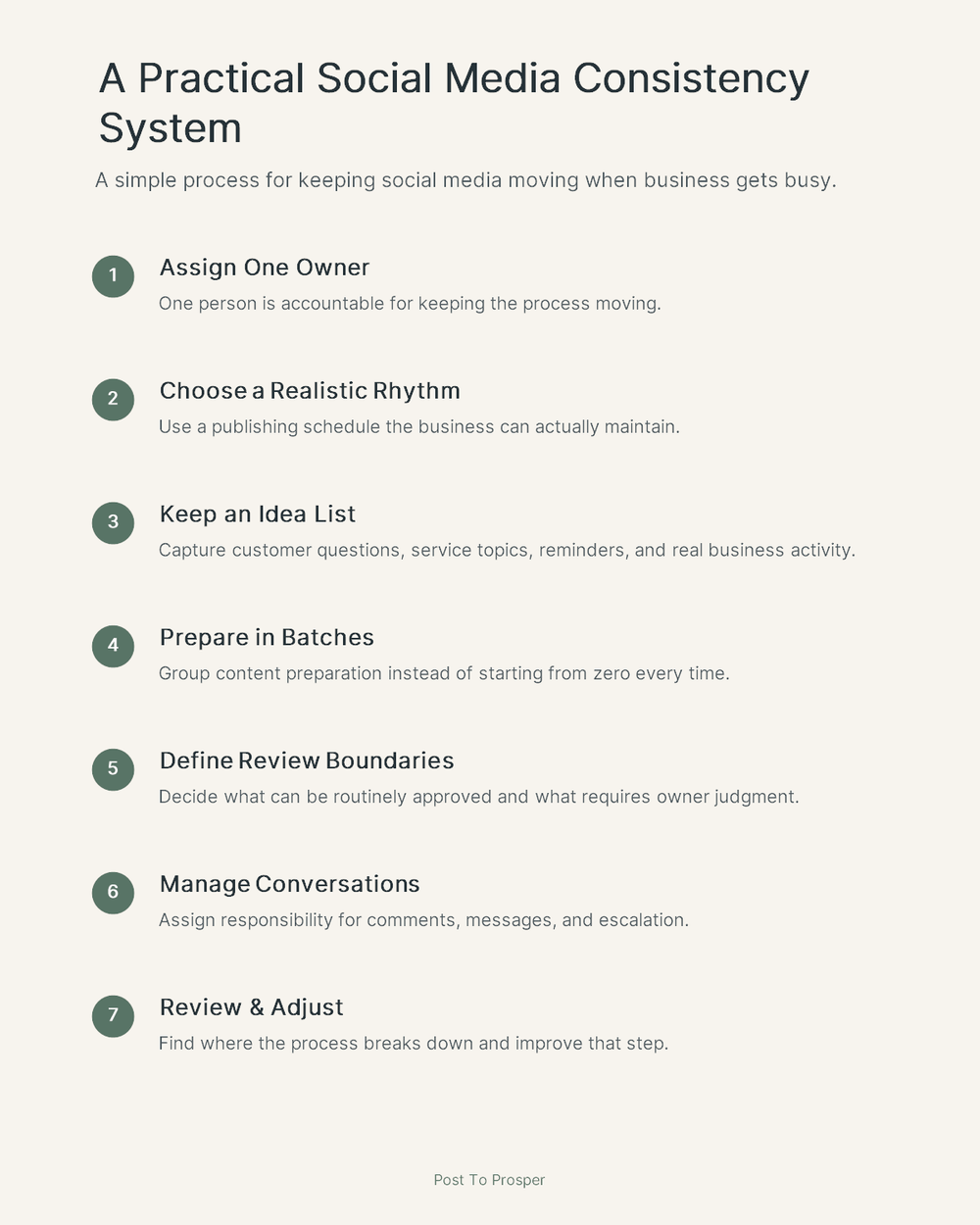
- Assign one accountable owner. Other people can contribute, but one person should know the current status and next step.
- Choose a realistic publishing rhythm. Base it on your available people and process, not on pressure to match another company.
- Keep a shared idea list. Capture customer questions, useful reminders, service explanations, and approved moments from day-to-day work.
- Prepare related work together. Collecting ideas, photos, and draft copy in focused sessions can reduce repeated setup and decision-making.
- Define review boundaries. Decide what can be approved routinely and what needs the owner’s expertise or judgment.
- Include comments and messages. Assign responsibility for checking conversations and escalating anything outside approved information.
- Review the process, not just the posts. If the routine keeps breaking, identify the step causing the delay and adjust it.
Keep the system simple enough that everyone involved can explain it. Complexity doesn’t create consistency. Clear ownership and repeatable steps do.
When DIY Management Is Still Reasonable
Managing social media yourself can be a sensible choice when someone in the business has the time, interest, judgment, and authority to own it. A clear internal process may be all you need, especially if your content needs are straightforward and your team can respond to customer conversations reliably.
Software can also be useful when you already have someone who can create content and manage engagement. A scheduling tool may make publishing more organized, but the business still needs people to decide what to say, provide accurate information, review the content, and handle responses.
Managed support may be worth considering when the responsibility repeatedly competes with work only you or your team can do. The question isn’t whether DIY is good or bad. It’s whether your current approach produces a professional, dependable presence without creating an ongoing burden the business cannot support.
Conclusion
Facebook and Instagram consistency is rarely fixed by trying harder for a few days. It improves when the work has an owner, a realistic rhythm, a source of useful ideas, clear approval boundaries, and a plan for customer conversations.
Your first step can be simple: decide who owns the process and define what that person will complete next. Once responsibility is clear, you can improve the rest of the workflow one part at a time.
Want social media to stop competing with everything else on your plate? See how Post To Prosper manages Facebook and Instagram for small businesses. See How It Works